architectural process

For many clients, the architectural process feels unclear before it begins.

That uncertainty is understandable—but it’s also avoidable.

A well-structured process doesn’t need to be complicated. In fact, the more complex it appears, the harder it becomes for clients to engage with confidently.

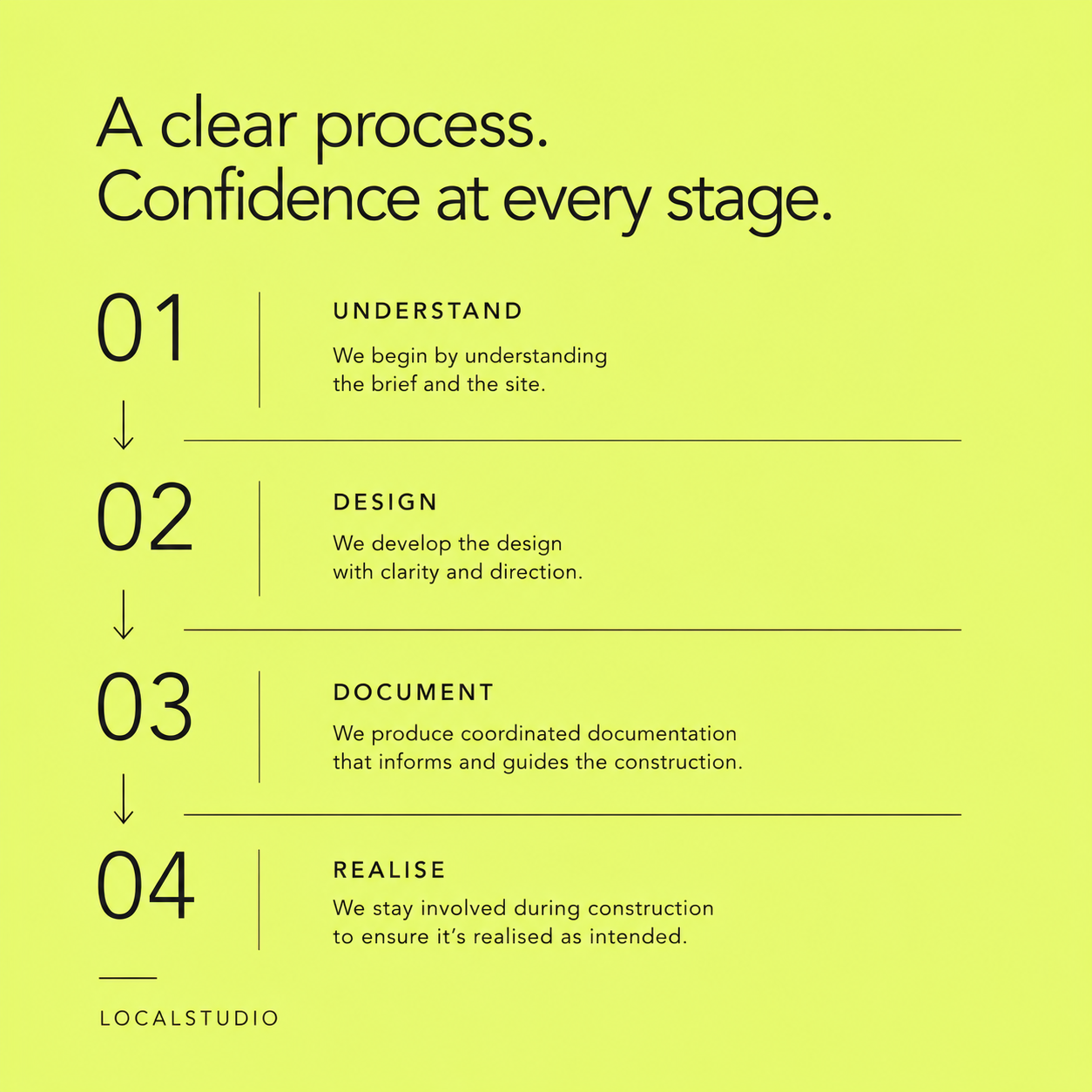
We begin by understanding the brief and the site.
We develop the design with clarity and direction.
We produce coordinated documentation that informs and guides the construction.
And we stay involved during construction to ensure it’s realised as intended.

Each stage builds on the last. Decisions aren’t rushed forward or deferred—they’re made at the right time, with the right information.

At Local Studio, we aim to keep the process as transparent and straightforward as possible. Clients understand where the project sits, what happens next, and which decisions need to be made along the way.

At the beginning of each project, we prepare a detailed Service and Fee Proposal outlining the project stages, scope, and deliverables so expectations are clear from the outset.

Good process doesn’t add complexity.
It removes uncertainty.

You can find out more about our process and the services we offer here.
Balancing Ambition with Economy

Every project sits somewhere between ambition and budget.

That tension is unavoidable—and, in many ways, necessary.

What’s less helpful is pretending it doesn’t exist, or assuming that a good outcome simply requires a bigger budget.

In practice, the opposite is often true.

Constraints create clarity. They force decisions about what genuinely matters—and what can be simplified, refined, or let go.

This might mean concentrating investment in key spaces rather than spreading it too thinly.
Choosing fewer materials, but using them more consistently.
Or refining a plan so it works harder with less.

These aren’t compromises in the negative sense. They’re part of the design process.

Some of the most resolved projects come from careful prioritisation, not excess.

Ambition isn’t about doing everything.
It’s about doing the right things well.

And more often than not, that leads to work that feels calmer, more considered, and ultimately more enduring.

Clarity vs Creativity

Creativity tends to be overemphasised at the beginning of a project.

Not because it isn’t important—but because it’s often applied too early.

At the outset, most clients aren’t lacking ideas. What they’re lacking is clarity. And introducing too many options too soon can make the process feel more complex than it needs to be.

In our experience, the early stages of a project benefit from direction and guidance, not divergence.

What are we trying to achieve?
What matters most—and what matters less?
Where should the budget be focused to have the greatest impact?

Without clear answers to these questions, creativity can easily become a distraction. The project starts reacting to ideas, rather than moving toward a clear design intention.

Clarity, on the other hand, creates momentum. It allows decisions to be made with confidence, and the design to evolve in a way that feels resolved rather than constantly shifting.

Creativity still plays a critical role—but it’s most valuable when it’s applied within a clear framework.

Good projects rarely come from having more ideas.
They come from understanding which ideas matter most.

Responding to the site

“Responding to the site” is a phrase that gets used a lot in architecture.

In reality, it’s often reduced to a gesture—something that sounds considered, but isn’t always followed through in a meaningful way.

A genuine response to site is quieter, and more deliberate.

It’s in the way light enters a room at different times of day.
How neighbouring buildings shape privacy and outlook.
Where level changes can be used, rather than concealed.
And how planning controls—often seen as constraints—can actually provide direction.

These factors aren’t obstacles to work around. They are the framework the project should grow from.

On many of our projects, the most important moves don’t come from a preconceived idea, but from paying close attention to what’s already there.

A living space shifts because of orientation.
An opening is adjusted because of a neighbouring condition.
A plan simplifies because the site suggests a clearer way forward.

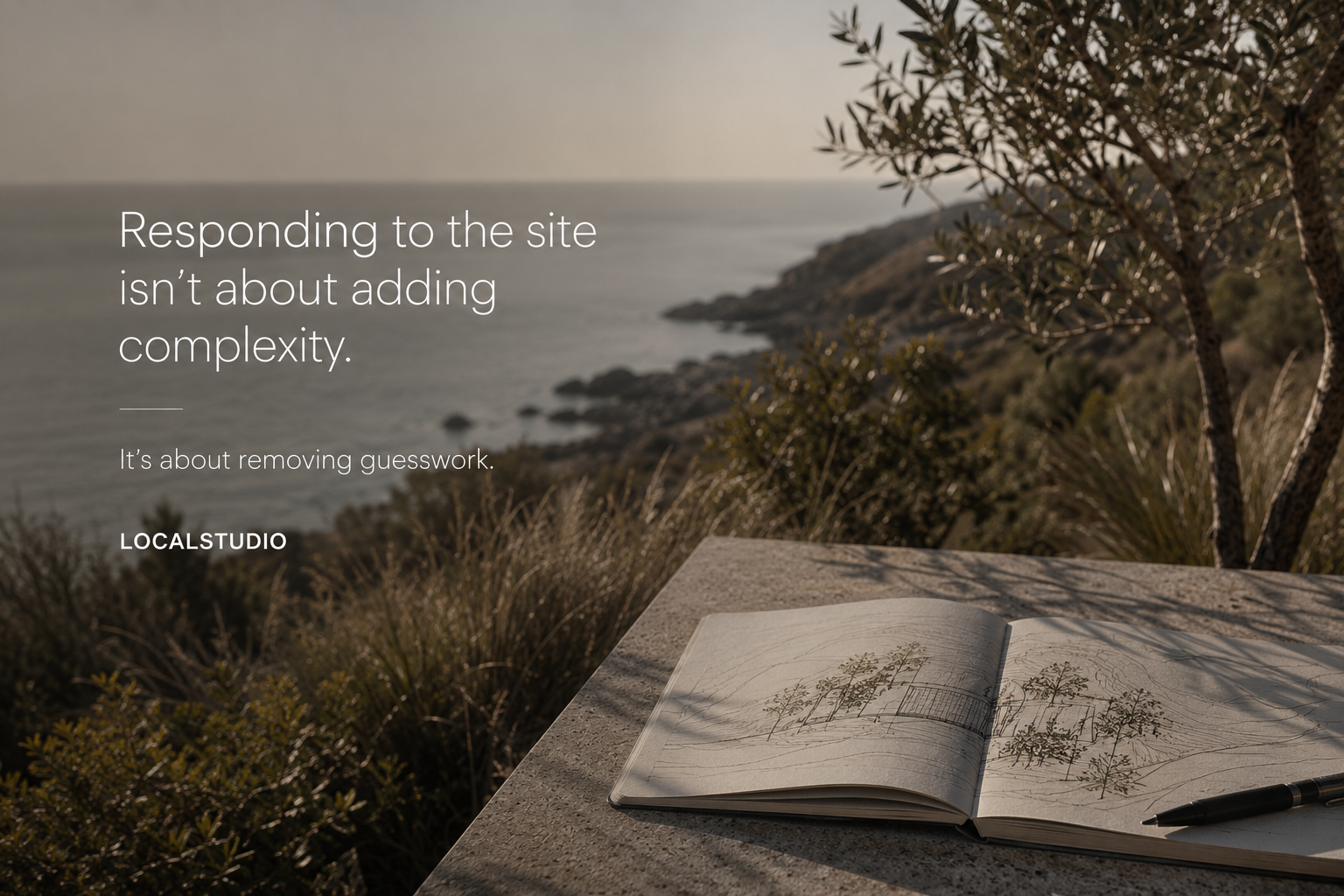
Understanding the site isn’t about adding complexity.
It’s about removing guesswork.

At Local Studio, this process of understanding and discovery forms a critical part of the Concept Design stage.

With a clear understanding of the site and brief established, we begin testing ideas through sketches, diagrams, models, and reference imagery.

This stage is exploratory and iterative. Ideas are developed, reviewed, and refined to establish a clear and considered design direction.

Before we draw anything, we listen

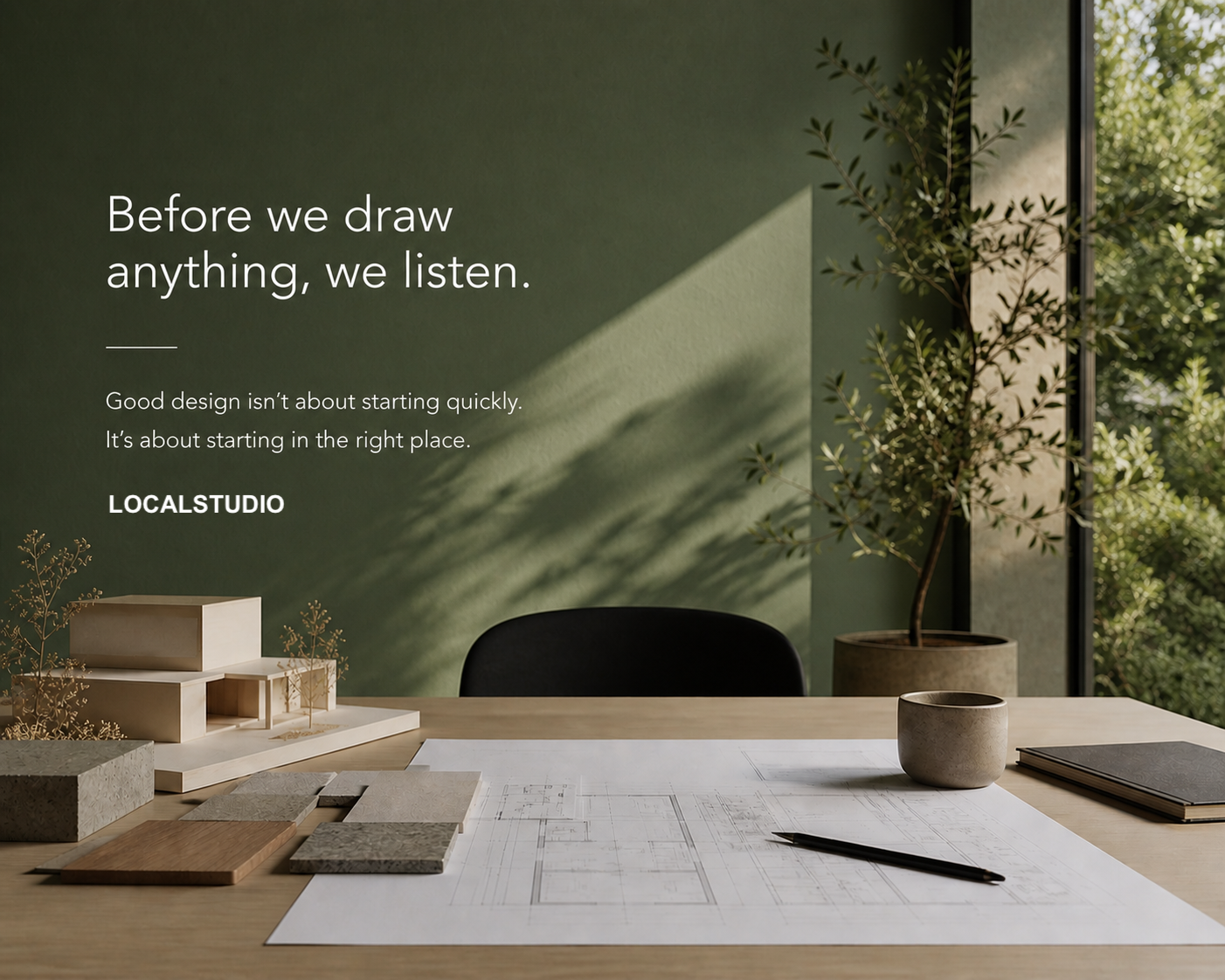
Before we draw anything, we listen.

It’s a simple idea—but one that’s often overlooked.

There’s a tendency at the start of a project to move quickly into plans and ideas. To “get something on paper.” It can feel productive, but more often than not, it leads to work that needs to be revisited once the real priorities become clear.

In our experience, projects don’t lose time in documentation or construction—they lose it right at the beginning, when decisions are made without a clear brief or a clear understanding of budget.

For us, the first step is always about understanding.

How do you want to live?
What does the site offer?
Where should we be ambitious, and where is restraint more appropriate?

These questions aren’t peripheral—they are the project.

Taking the time to properly listen doesn’t slow things down. It removes uncertainty, reduces rework, and allows the design to move forward with clarity.

Good design isn’t about starting quickly.
It’s about starting in the right place.

At Local Studio, we offer pre-design services.

Projects often begin with the need for early advice. We provide a range of preliminary services at a fixed, accessible fee, allowing initial ideas to be tested without commitment to the full design process.

This stage typically includes an initial consultation, followed by feasibility and budget considerations. It establishes the foundation for a detailed fee proposal and a clear project brief.